Bronx Apartment Collapse Underscores That Money Alone Would Be Inadequate To Fix New York’s Public Housing
Management practices leading to the 177,000-unit public housing system being termed the city’s largest slumlord need reform.
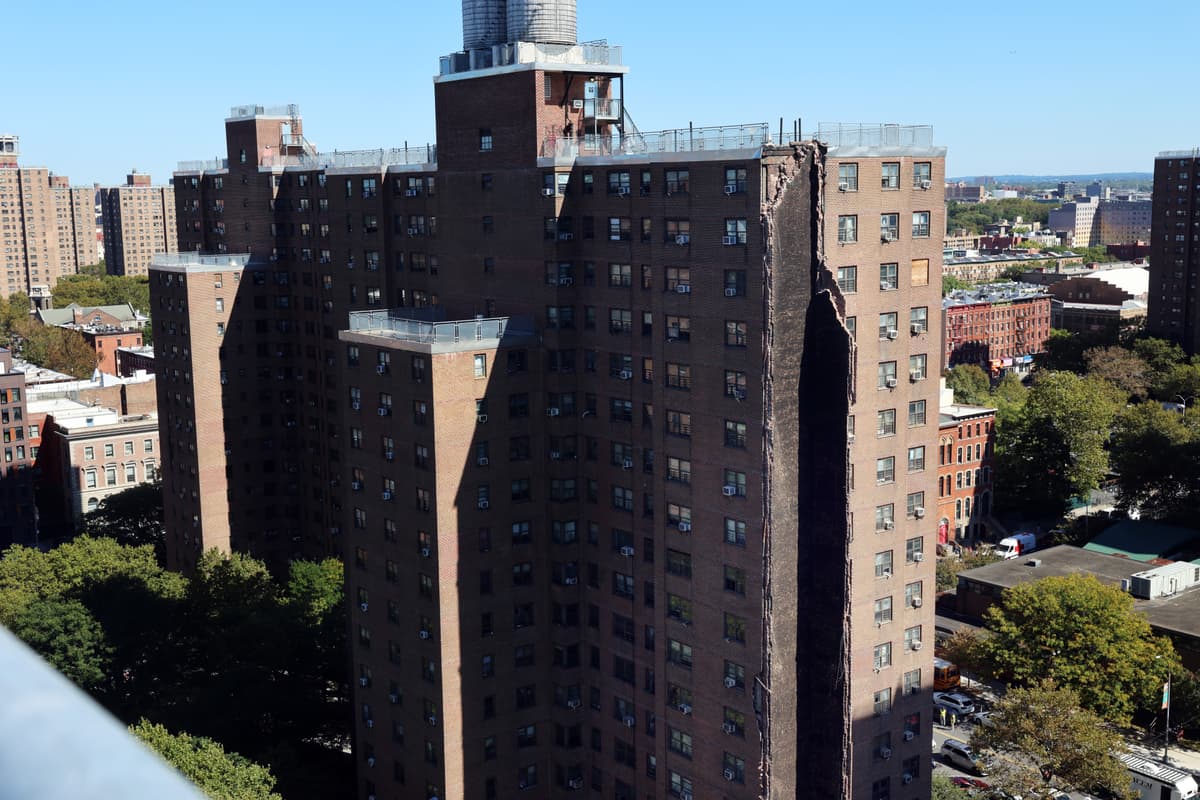

The deep maintenance problems of the nation’s largest public housing system took dramatically visible form Wednesday with the partial collapse of a 28-story Mitchel Houses building at the Bronx, displacing 140 residents. That no one died was a near-miracle.
On cue, protesters, including Representative Richie Torres, the next day decried “chronic underinvestment” as the cause of the gas explosion that occurred when workers tried to turn on the heat for the coming cold weather. Protest signs, as if cued by Zohran Mamdani, called for “billionaires” to be taxed to pay for repairs.
It’s true that it takes funding to pay for repairs — but money alone won’t be enough or even guarantee improvement absent change in the management practices that have led to the 177,000-unit public housing system being (correctly) termed the city’s largest slumlord.
Even if so much housing is to remain publicly-owned, it must be privately managed. State law meant to bring new funding to the aging system stands in the way.
It’s important to understand the extent of the problem. The Mitchel Houses explosion should be seen as a near worst-case example of the problems that plague New York City Housing Authority residents every day.
The website “NYCHA outages” tells the story. In the last week of September alone, there were elevator failures at 27 buildings in the Bronx, Manhattan and Queens. At the Adams Houses at the Bronx, hot water was out, as well. Keep in mind that 45 percent of residents are aged 62 or older and 30 percent are disabled. No elevator service means they can’t get outside to shop for groceries.
Both state government and NYCHA are well aware of the estimated $78 billion in the deferred maintenance that leads to leaks, molds, rodents and now a building collapse. But its solution raises new concerns.
The state’s Permanent Affordability Commitment Together programs, passed in 2016, offers the chance to combine building renovation with private management. It’s led to the full-scale fix-up of the Baychester Houses in the Bronx and a planned $783 million overhaul of the Edenwald Houses.
Yet the funds protestors demand has been stalled elsewhere — not by Washington but by public housing tenants. Under state law, tenants get to vote as to whether they want private or public management, along with a new federal funding arrangement that finances fix-ups by “voucherizing” tenants — that is, to link their subsidies to a housing voucher revenue stream that can finance repairs.
Resident at two projects — Jacob Riis at Manhattan and Throggs Neck at the Bronx, frightened by the spectre of “privatization” — voted instead for the status quo. At the Hylan Houses on Staten Island, residents backed private renovation but to keep NYCHA, not a private management firm, in charge after repairs.
It’s worth noting that fully 22 percent of the NYCHA workforce lives in public housing — giving employees a vote in whether to bring in private management. This is the same workforce that included 70 employees charged, in February, 2024, with bribery and extortion in the repair contracting process.
Apart from politics, it’s hard to understand why tenants should get a vote at all in determining the best way to finance repairs to their building, so long as they retain legal protections against eviction (which they do).
Tenants are simply not real estate finance experts and should not be expected to be. That they would, by vote, actually block new sources of funding sets the stage for more Mitchel Houses-style tragedy — to be followed, to be sure, by protests.
The time has come, instead, for imaginative new approaches. NYCHA-owned projects, for instance, stand on some of the most valuable real estate in the city.
Relocating tenants in projects on the Brooklyn waterfront or Lower East Side and freeing the land for new, private development could bring in a tsunami of revenue that could help repair projects across the city.
The Mitchel Houses building collapse dramatizes the need for public housing repair in the nation’s largest system. New funding, though, absent other change, won’t do the job.

