Hopes for Israeli-Lebanese Peace Are Threatened by Hezbollah’s Military Growth
An unprecedented meeting between Beirut and Jerusalem was ‘an initial attempt to establish a basis for a relationship and economic cooperation,’ Netanyahu says.
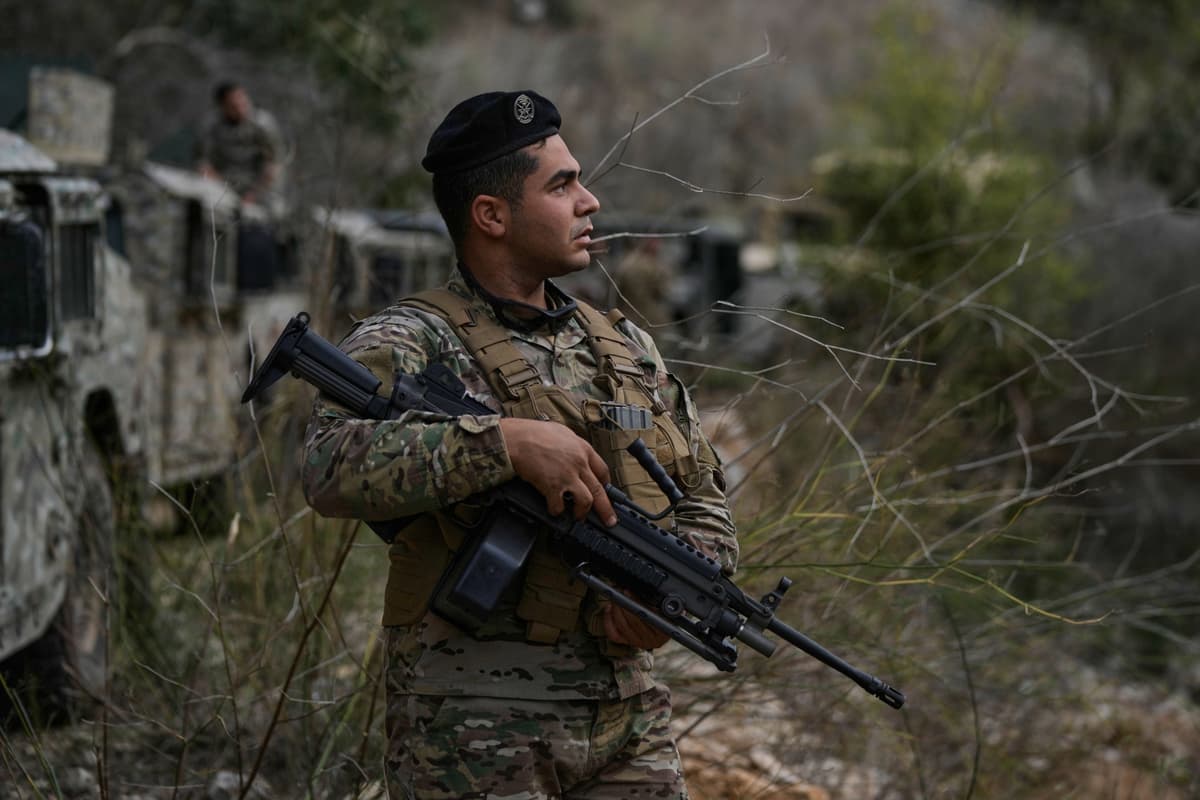

In a possible breakthrough for Middle East peace, Israeli and Lebanese civilian officials met on Wednesday for the first time to discuss economic and other possible cooperation. At the same time, the Iran-backed Hezbollah’s rearming efforts dim hopes for future ties between the neighboring countries.
“There are two parallel tracks now, the disarmament of Hezbollah and a peace process with the Lebanese government,” the founder of the northern Israel-based Alma Research Center, Sarit Zehavi, tells the Sun. “Right now these tracks aren’t contradictory, but they might clash if Hezbollah remains armed.”
The meeting at Naqoura, Lebanon, was attended by a member of Israel’s national security council, Uri Resnick, and a former Beirut ambassador to Washington, Simon Karam, who was named by President Joseph Aoun to head the Lebanese negotiation team. President Trump’s envoy, Morgan Ortagus, who travelled to Jerusalem earlier, was also at the Naqura meeting.
In the past, Israeli and Lebanese military officials had met periodically under the auspices of the United Nations Interim Force in Lebanon in attempts to prevent flareups. This is the first time, though, that civilians from both countries are conducting direct talks. By law, Lebanese civilians are banned from meeting Israelis.
The Wednesday meeting “is an initial attempt to establish a basis for a relationship and economic cooperation between Israel and Lebanon,” Prime Minister Netanayhu wrote on X.
Also on Wednesday, 14 ambassadors to the United Nations from the 15-member Security Council landed at Beirut, where they launched a 4-day trip to Lebanon and Syria. Ambassador Samuel Zbogar of Slovenia, who serves as president of the council for December, and who initiated the trip, says that the aim is to show support for the new Lebanese and Syrian governments.
After spending a day at Beirut, the council members are expected to travel to Damascus Thursday, where they will be greeted by interim president, Ahmed a-Shara — a man who was removed earlier this year from a UN list of sanctioned terrorists. In addition, the diplomats will meet representatives of Syria’s Druze and Alawites, two communities that were recently massacred by Islamist allies of Mr. Shara.
On Friday, the ambassadors will return to Beirut to meet Mr. Aoun, Prime Minister Nawaf Salam, and the speaker of the Lebanese parliament, Nabih Beri.
“The first thing they need to ask these guys is why has Lebanon defied the council for two decades,” Ms. Zehavi says. “When I see daily reports from the Lebanese government or from Unifil that detail what kinds of Hezbollah weapons they found today, and where, then I’ll believe they are doing something.”
Mssrs. Aoun and Salam have presented plans and time tables to disarm Hezbollah according to Security Council resolutions and last year’s cease-fire agreement. They are yet to act on their promises though. While Unifil often reports on Israeli violations of Lebanese sovereignty, it rarely notes the underlying reason for those incursions, which is Hezbollah’s rearming efforts, backed by Tehran.
The Lebanese challenge is that “you have violations of the ceasefire” by Israel, the Slovenian ambassador, Mr. Zbogar, told reporters ahead of the council’s trip. “Also you have one promise of the cease-fire, is that it’s only state apparatus that will carry arms. And that means disarmament of Hezbollah.”
Following the trip to Lebanon, the American UN ambassador, Mike Waltz, is expected to arrive at Jerusalem for meetings with Mr. Netanyahu and other officials. Much reporting in Israel and Washington is on a demand by Mr. Trump: Israel must do all it can to preserve the cease-fire with Lebanon, which was mediated last November by President Biden’s team.
At the same time, though, Washington is sympathetic to Israel’s vow that following October 7, 2023, it will prevent the growth of Iran-backed armies that profess to have the destruction of the Jewish state as their goal. Last year the Israel Defense Force decimated much of Hezbollah capabilities, and it is increasingly making clear it would do so again if necessary.
For now, the Lebanese Armed Forces, which boasts a large Shiite personnel, has been unable, and largely unmotivated, to confront the powerful Hezbollah. “Some of us are hoping that Israel will do the work for us,” a Beirut source tells the Sun. Yet fears of a destructive renewed war, not to mention a subject that remains taboo in Lebanese discourse, prevent anyone from saying so publicly.

