Welcome to Washington: JD Vance Can Expect a Fight for the 2028 Nomination
The president’s stubbornly low approval rating may well open a door for ambitious Republicans.
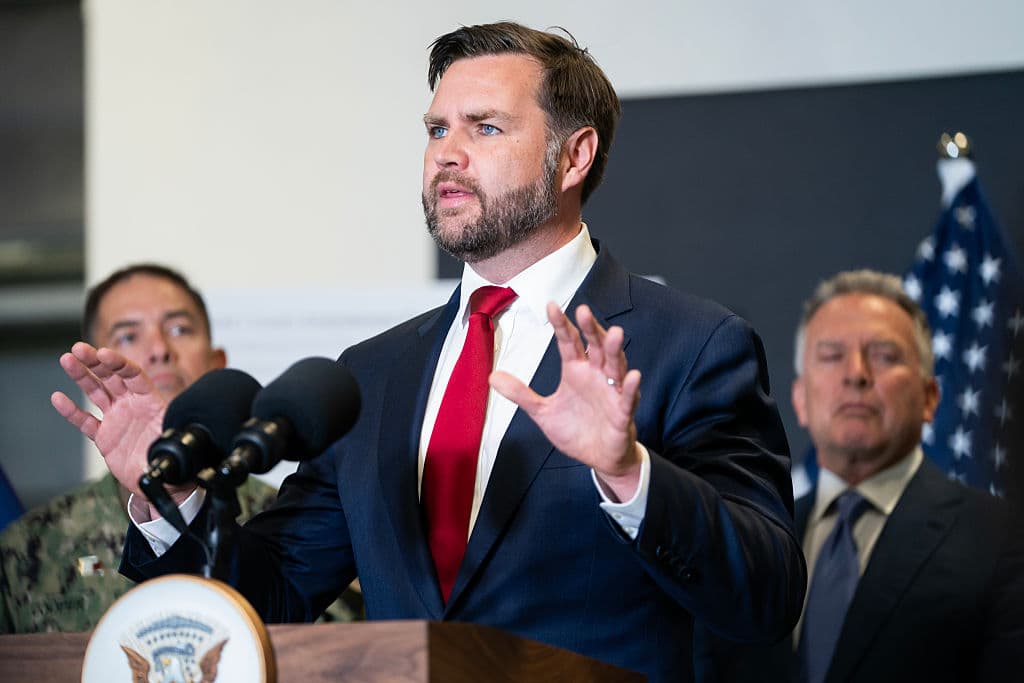

Vice President Vance is like President Trump in the sense that he has walked the path between two very different worlds — the technology executives of Silicon Valley and the nativists in the GOP; between the halls of Yale Law School and the dilapidated communities of southwestern Ohio; and now between Mr. Trump’s final term in office and his own ambitions for an administration of his own.
Welcome to Washington, where in the last few weeks it appears that the Republican trifecta is more dysfunctional than ever. With one week to go until they leave town for the holidays, our pols have left countless issues to tackle by a GOP hurtling toward a bitter fight about a post-Trump future.
Mr. Trump himself seems to care little about the fate of his party. Last week, during a rally in Pennsylvania, he complained to the crowd that his own chief of staff was asking him to campaign ahead of the 2026 midterms.
“[T]he chief of staff … She said, ‘We have to start campaigning, sir,’” Mr. Trump recounted. “I said, ‘I won. What do I have to do? Already?’ They said, ‘We have to win the midterms and you’re the guy that’s going to take us over the midterms.’”
The president isn’t just expressing his lack of interest in the success of his party out loud — he is actively ignoring domestic political events for fellow members of the GOP. In 2017, he headlined several events for Republican candidates in special elections. This year, he has held zero in-person rallies for GOP candidates despite a number of consequential races taking place.
The lack of his engagement in on-the-ground events and key policy debates has left a vacuum within the Republican Party. Mr. Trump flip-flops on the issue of transparency in respect of his campaign against President Nicolas Maduro of Venezuela, defends the importation of foreign employees while imposing fees on applications, and is largely absent from the fate of government involvement in the regulation of health insurance costs.
The one person most likely to suffer from this is Mr. Vance, who — like all vice presidents with dreams of sitting behind the Resolute Desk — is stuck between charting his own course in the future of his own party and the nation as a whole and the required obsequiousness to the president who works just down the hall.
It is not too early to start discussing what this means for the vice president’s future. We are now closer to the start of the 2028 campaign than we are to election day in 2024. Less than one year from now, it is more likely than not that there could be at least half-a-dozen people officially running for president.
Though the Democratic field could be larger than the 2020 primary — which featured 25 candidates in total — Mr. Vance cannot simply hope for a coronation. There are several members of the GOP who could hop into the race to give the vice president a run for his money, though he would obviously be the frontrunner.
On immigration, Governor Ron DeSantis of Florida has already started being more outspoken on the issue of high-skilled employees being brought here to the United States, even though the president is enamored with the status quo. Mr. DeSantis is cracking down on his state’s universities hiring H-1B visa holders.
On avoiding foreign entanglements, Senator Rand Paul could very well find some fans in the party — just as his father, Congressman Ron Paul, did in both 2008 and 2012. Dr. Paul has demanded more transparency and a restriction of the use of military force in respect of Mr. Trump’s campaign in the Caribbean.
On the cost of living crisis, Congresswoman Marjorie Taylor Greene — a onetime devotee of the president who is now quitting Congress altogether — has spoken out forcefully that her party is failing to live up to its promises. Though she denies having ambitions for a higher office, her scorched-earth style campaigning may play quite well among the rural base of the party, especially if Mr. Trump’s approval rating remains low.
Last year, Vice President Harris benefited from President Biden deciding to withdraw from the race just one month before the Democratic convention. She was never forced to face her party’s primary voters, and it’s clear in hindsight that she would have had to battle for the Democratic nomination had Mr. Biden announced he would be a one-term president following the 2022 midterms.
Based on current polling, it is obvious that Mr. Vance is by far the most likely to be the Republican nominee in 2028, though he rarely registers higher than 50 percent among GOP primary voters. For any person seeking to challenge him by the end of next year — even if it is a quixotic mission — there is apparently room for someone to put up a fight.

