Letitia James Attacks Prosecutor Probing If She Violated Trump’s Civil Rights, as Bondi Prepares To Charge Her Again With Fraud
New York’s attorney general is seeking another prosecutorial disqualification as a grand jury weighs a new indictment.
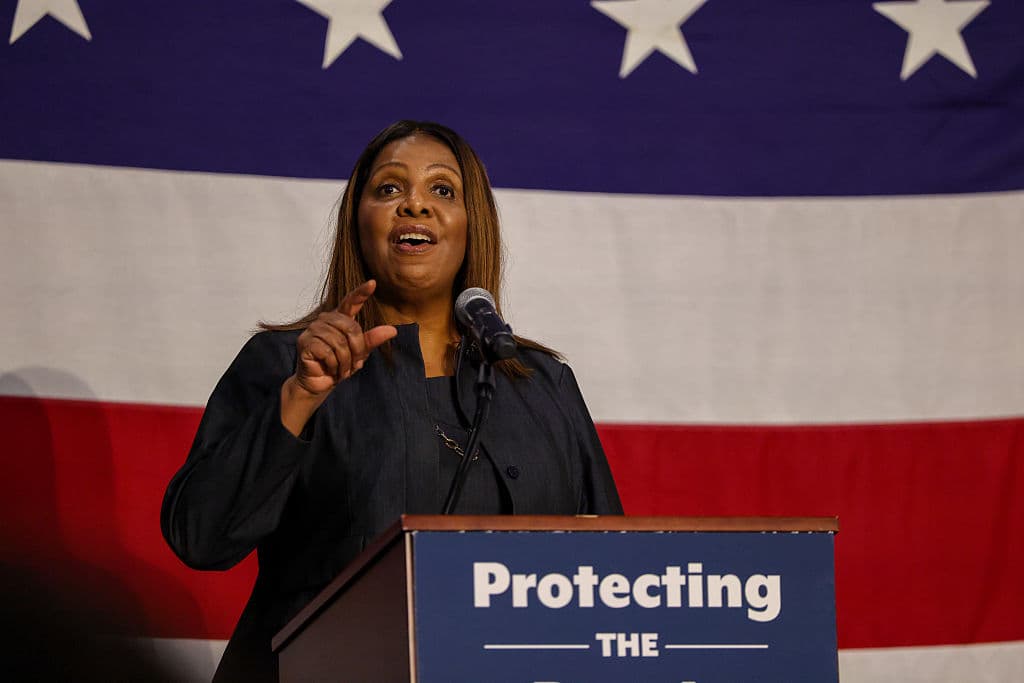

The hearing on Thursday devoted to the question of whether the acting United States attorney for Northern New York, John Sarcone, lawfully holds his job puts in sharp relief the battle over the Trump administration’s appointment of prosecutors — which is at the center of its efforts to prosecute prominent figures like New York’s attorney general, Letitia James.
The challenge to Mr. Sarcone comes from Ms. James, who wants the court to quash subpoenas she is facing from Mr. Sarcone. He is working with a grand jury to bring civil charges against Ms. James for violating President Trump’s civil rights when she sued him, his adult sons and his family business for civil fraud.
Mr. Sarcone is also said to be preparing to charge Ms. James with violating the civil rights of the National Rifle Association, which she also sued. In both of his investigations, Mr. Sarcone is seeking to prove that Ms. James was motivated by political considerations — the NRA and Mr. Trump are deeply unpopular among New Yorkers — to the extent that Mr. Trump’s federal or constitutional civil rights were trodden upon.
Also on Thursday, though, a Virginia grand jury was convened to weigh handing up a second indictment against Ms. James for mortgage fraud after the charges against her were dismissed last week after a judge ruled the prosecutor was unlawfully appointed.
Mr. Sarcone’s office has issued two subpoenas against Ms. James. The first concerns her litigation against the NRA, which had the misfortune of being incorporated in New York in 1871. Her lawsuit upended its leadership and resulted in millions of dollars in fines. The second subpoena related to Ms. James’s civil fraud lawsuit against the Trumps.
Ms. James’s lawyers, in their motion to quash the subpoenas, write that “the Executive Branch seeks to transform a personal grievance, which failed as civil claims, into a federal criminal prosecution — a plain and calculated campaign to harass a law enforcement agency that held Mr. Trump and his organization to account.”
Ms. James, an elected Democrat, promised in her 2018 victory speech to “shine a bright light into every dark corner” of Trump’s real estate dealings. Her resulting fraud case led to a $500 million fine and a robust array of restrictions on the ability of the Trumps to practice business. An appellate court wiped away the fine, finding it so “excessive” as to violate the Eighth Amendment to the Constitution. Now Mr. Sarcone is investigating — hence the subpoena — whether that case violated the president’s civil rights.
Mr. Sarcone, a stalwart Trump supporter from the Greater New York City area, was sworn in as interim United States attorney upstate in Albany — New York State’s remote capital — on March 17. That appointment, by statute, expired after 120 days. In the summer the federal judges in his district, overwhelmingly appointed by Democratic presidents, declined to extend Mr. Sarcone’s term. For Mr. Sarcone to be confirmed by the Senate, he would require, under the tradition of “blue slipping,” the support of New York’s two Democratic senators, Chuck Schumer and Kristen Gillibrand. That appears unlikely.
Mr. Sarcone is also supervising the government’s response to a lawsuit brought by the daughter, Maurene Comey, of former FBI director James Comey. Ms. Comey is a former prosecutor in the Southern District of New York, and Ms. Bondi sent the case to the hinterlands of Albany after it was initially filed in Manhattan.
Ms. Comey, who led the prosecutions of Jeffrey Epstein, Ghislaine Maxwell, and Sean “Diddy” Combs, alleges that her firing — which came after she suffered a steback in the Combs case — was unconstitutional. The government this week indicated that it plans to move to dismiss the case.
Mr. Sarcone gained some notoriety in June when he called the Albany sheriff on his personal cell phone to report that he was being chased outside of a hotel, he told Fox News, by “a maniac with a knife who was speaking in a foreign language.” The man, Saul Morales-Garcia, was arrested and charged with attempted murder. That charge was dropped following a review of surveillance footage by Albany’s district attorney. Mr. Morales-Garcia eventually pleaded guilty to second degree menacing.
Ms. James is fresh off some initial success in Virginia, where the prosecutor, Lindsey Halligan, in charge of the mortgage fraud case against her — and the perjury one against Mr. Comey — was disqualified as unlawfully appointed by Attorney General Pam Bondi. The judge, Cameron McGowan Currie, an appointee of President Clinton, dismissed the cases against both Ms. James and Mr. Comey. Ms. Bondi has vowed an “immediate appeal.”
The rub for Ms. Halligan — at least according to Judge Currie — is that she was the second consecutive interim appointment to lead the Eastern District of Virginia. Her predecessor, Erik Siebert, was also an interim appointment, and reportedly resigned over a reluctance to prosecute Ms. James and Mr. Comey. Federal law appears to limit the ability of the attorney general to make consecutive interim appointments. The second such appointment, Judge Currie ruled, must come from the judges in the district.
Appointment woes have also tripped up the Trump administration in New Jersey, where the president tapped Alina Habba to serve as interim United States attorney. She is unlikely ever to make it past the blue-slipping gauntlet of the state’s two liberal Democrats senators, Cory Booker and Andy Kim. Ms. Habba was first disqualified by a federal district court judge, Matthew Brann, a Republican who was appointed by President Obama.
The chances of Ms. Habba proceeding to confirmation appear close to nil due to her prosecution of two prominent Democrats of color. She charged the mayor of Newark, Ras Baraka, as well as Congresswoman LaMonica McIver, with felonies following a melee at a Garden State ICE facility. The charges against Mr. Baraka were dropped, but those against Ms. McIver last month survived a motion to dismiss on the basis of legislative immunity.
Earlier this week a panel of the Third United States Appeals Circuit upheld Judge Brann’s disqualification. The three appellate jurists reasoned that “under the Government’s theory, Habba may avoid the gauntlet of presidential appointment and Senate confirmation and serve as the de facto U.S. Attorney indefinitely. This view is so broad that it bypasses the constitutional (appointment and Senate confirmation) process entirely.”

