Luxembourg Celebrates ‘the American St. Nick’ Eight Decades After a World War II Act of Kindness
By December 1944, when the 28th Infantry Division reached Wiltz, Santa Claus had been MIA for years. And then . . .
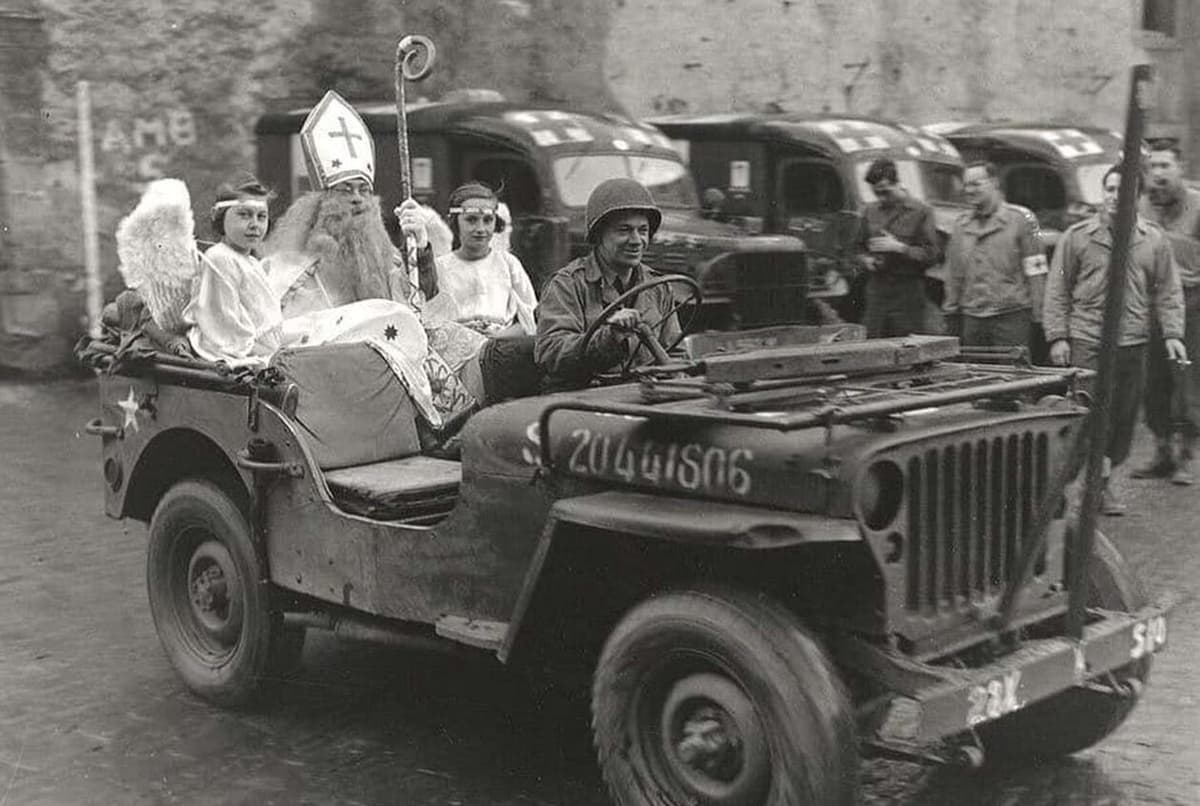

“The American St. Nicholas,” a legend unknown to most Yanks, is warming the hearts of Luxembourg’s children for the 81st yuletide. A World War II legend, he testifies to how, even in times of great evil, the Christmas spirit brings joy to the world.
Darkness fell over Wiltz, Luxembourg, when the Nazis invaded in 1940. Two years later, the Rhode Island-sized country was annexed, and “Germanization” began. The cultural erasure banned speaking Luxembourgish, remade Christmas in Adolf Hitler’s secular image, and outlawed St. Nicholas Day or Kleeschen to kick off the season.
Stateside, “stockings” are “hung by the chimney with care,” as the American poet, Clement Clarke Moore, wrote in 1823’s “A Visit from St. Nicholas.” The youth of Luxembourg put shoes and boots outside their windows, also “in hopes that St. Nicholas soon would be there,” leaving candy, fruit, and gifts.
By December 1944, when the 28th Infantry Division reached Wiltz, Santa Claus had been MIA for years. The author of “The American St. Nick: A True Story,” Peter Lion, told this columnist for the History Author Show that the unit had just fought the Battle of Hürtgen Forest, a “meatgrinder.”
One soldier, Corporal Harry Stutz, heard that the Grinch in Berlin had stolen Christmas from Wiltz and resolved to return it. “This is something that the whole town would turn out for,” Mr. Lion said of the pre-war festivals. But in 1944, “they had nothing with which to celebrate.”
It’s one of the “ironies of the story,” Mr. Lion said, that Stutz “was a Jewish soldier” who knew “nothing about Catholic traditions or holidays or anything like that.” He had to “go to the local priest to find out what it is he has to do to make St. Nicholas Day happen.”
Due to the language barrier, Mr. Lion said, the locals “didn’t quite get it.” Maybe it was “not even so much they don’t understand” what Americans were saying. They were just in awe of the audacious generosity. “We’re in the middle of a war,” the author said of the reaction, “and you’re fighting, and you want to throw a party for the children?”
Stutz persisted even as artillery fire sounded in the distance while his fellow soldiers dug into their haversacks for candy and gum. The mess baked cookies. Getting into the spirit, Wiltz’s leaders began eyeing Corporal Richard Brookins. He bore, they said, an eerie resemblance to the St. Nick of local legend.
At Stutz’s suggestion, Brookins scrounged up a bishop’s robe, hat, and staff. He then mounted a jeep and rode through town, bracketed by two young girls dressed as angels. The World War II Foundation produced a documentary on the event, “The American St. Nick,” in 2015.
Gene Schweig, 16 during the celebration, tracked down Brookins in 1977 and invited him back to Wiltz. The event had been just a few forgotten hours of happiness for the GIs. Yet the townsfolk remembered, incorporating “the American St. Nicholas” into their annual tradition and festooning their streets with the Stars and Stripes.
Brookins in 1977 reunited with the girls he called “my angels” and returned again in 1994, 1999, 2004, and 2014, greeted by thousands of children. In 2016, Luxembourg gave him their highest award, the Military Honor Medal. His legend endures — a bright spot that proved all too brief amid the horrors of war.
Ten days after the celebration, the Wehrmacht launched a counteroffensive and 85 percent of Wiltz “was just laid to ruin,” Mr. Lion said, in the ensuing Battle of the Bulge. “Sadly, some of the children that had been at this party were killed. … The last, best memory of their lives was that Santa Claus or that St. Nicholas party.”
Stutz passed away in 2011 and Brookins in 2018. Appreciation for their gift lives on in Luxembourg, which honored “the American St. Nick” with two postage stamps last year. “We weren’t much more than kids ourselves, really,” Brookins recalled of how he became a Christmas legend. “It was a chance for us to have a party, too.”

