MAGA Goes Global, as Trump’s Foreign Policy Moves Make America’s Allies Great, Too
The ‘liberal international order’ he is upending is a suicide pact, building up Communist China while wearing down America.
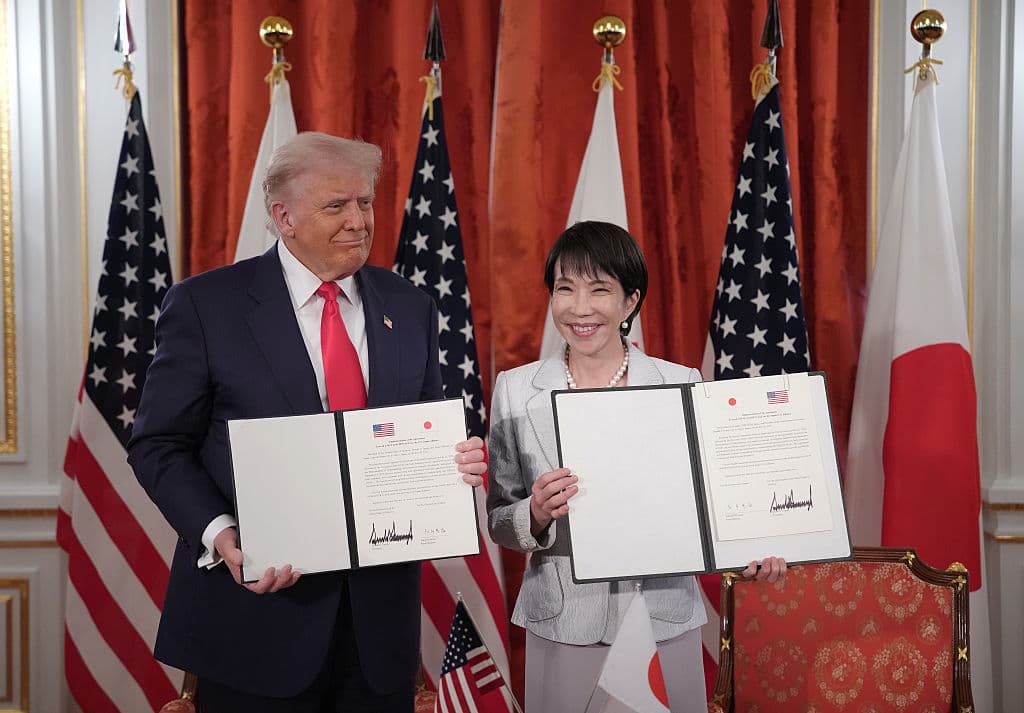

From Argentina to Japan, MAGA is going global.
President Trump’s slogan has long been “America First,” and his movement is all about making America great again — language the president’s foes misunderstand as meaning “isolationism.”
Yet strengthening America requires strengthening our friends as well — and Trump sets an example for those leaders in Latin America, Asia, and Europe who want to make their nations great again, too.
There’s no paradox here:
A robust international order is impossible if America has to sacrifice its own industrial capacity, and our people’s economic security, to global free trade. That led to a weaker, more dependent America, even as our allies, in the era before Trump, expected us to shoulder most of the burden for their defense.
The “liberal international order” was a suicide pact, building up China while wearing down America — and the system perversely incentivized our friends to prioritize welfare spending over national security needs.
The alternative to that old, failed order isn’t anarchy or Chinese hegemony; it’s cooperation among stronger nations that take their responsibilities — to their own people and to Uncle Sam — more seriously.
Japan is a critical case in point.
Its new prime minister, Sanae Takaichi, represents a right turn for the dominant Liberal Democratic Party, which is Japan’s leading conservative party, despite what the name might suggest.
More than 80 years after the end of World War II, Japan remains constitutionally forbidden to rearm: it has defense forces but not true military.
Ms. Takaichi belongs to a wing of the Japanese right that would change that — and thereby make Japan no threat to anybody else but a better ally for America.
The superpower danger in the Pacific today comes from Beijing, and the more constrained Japan is, the less constrained that China is.
Rearmament is highly controversial within Japan, but just as Mr. Trump has taken controversial yet necessary steps to address America’s weaknesses — from imposing tariffs to cracking down on illegal immigration — a leader like Ms. Takaichi can bring great changes to her country.
She’s already restricting immigration before it becomes the kind of problem it has long been in the West.
Ms. Takaichi is a protege of the prime minister during Mr. Trump’s first term, Shinzo Abe, who had a uniquely strong bond with him.
As the first woman to lead Japan, she’s also drawn comparison to Britain’s Iron Lady of the 1980s, Margaret Thatcher.
Tariffs that serve America’s industrial policy put a strain upon trading partners like Japan, of course — although the land of the rising sun has long practiced its own forms of industrial and agricultural protection.
Japanese rice production, for example, is heavily protected — which means Japan has enough domestic capacity to endure shortages in the event of war or other disruptions of international trade.
Although Japan isn’t self-sufficient, it’s a boon to American security that the country can provide for itself better than some of our other friends in the region, such as Taiwan — which could be starved into submission by a Chinese blockade.
Trump not only shows leaders like Ms. Takaichi that boldness can succeed in throwing out the political establishment’s playbook; his return to power prods allies like Japan to pick leaders simpatico with his right-leaning nationalist worldview — and those are the kind of leaders America needs among its allies in the 21st century.
Right-of-center, anti-establishment politics also plays well for Trump-friendly leaders at home, both with voters and the stock market:
Ms. Takaichi’s ascent sent the Nikkei stock index soaring to a new record.
Half a world away, the success of President Javier Milei’s right-leaning party in Argentina’s midterm elections Sunday produced a similar result, with stock indexes booming by as much as 23 percent.
It baffles Mr. Trump’s critics that America’s self-declared “Tariff Man” can have such good relations with Mr. Milei, a self-described “anarcho-capitalist.”
Yet Mr. Trump thinks in terms of interests, not ideology, and it’s in America’s interests that Mr. Milei succeed in making Argentina freer, more prosperous and friendlier to us, in a region — our own neighborhood — where socialism, anti-Yanqui sentiment and Chinese influence continually threaten to align against us.
There’s no contradiction in nationalists from different nations working in parallel to make their own countries stronger individually and more secure collectively.
Likewise, there’s nothing strange about populist reformers from different places with different needs having sympathy for one another — Mr. Trump is fighting an establishment bent upon globalization; Mr. Milei faces an establishment in Argentina that wants an all-powerful state.
Bringing different philosophies together to advance shared interests is simply the art of the deal.
Mr. Trump is the master of that, and other leaders around the world are quickly learning from him.
They’re advancing a global realignment that will contribute to making America great again, even as it makes their own nations greater as well.
Creators.com

