The AfD Question Is Coming of Age
The hard-right party relaunches its youth wing and courts the burghers of German business.

The firewall separating the hard-right Alternative for Germany party from German politics is a little more porous after the party was invited to a networking event at Berlin in October. The Financial Times reported earlier this week that the invite came from the Association of Family Businesses, which represents what Germans call the Mittelstand, some 6,500 small and medium-sized businesses. The AfD, it seems, is tiptoeing toward the mainstream.
The association has since backtracked and apologized, but the imbroglio illustrates how the issue of the AfD’s growing electoral strength is going precisely nowhere. The FT reckons that the growing closeness between the AfD and the burghers of German business has “prompted wider soul-searching in a country that has made learning the lessons of the Holocaust a central part of its postwar identity.”
It turns out, though, that the AfD’s economic policy spokesman, Leif-Erik Holm, had attended one of the association’s events even before the issuance of a formal invitation. The managing director of the business association, Albrecht von der Hagen, said after word of the invitation broke that “the firewall against the AfD” has achieved “nothing” and that “we are saying goodbye to firewalls.” The association includes BMW and Volkswagen.
The chairwoman of the association, Marie-Christine Ostermann, took to LinkedIn to reason that she “absolutely does not want to see the AfD as a coalition partner in any government” but that “we have to engage in dialogue with AfD politicians.” The Brandmauer, or firewall, she reckons, cannot long survive. The party is now the largest opposition party in the Bundestag, and polling has it waxing.
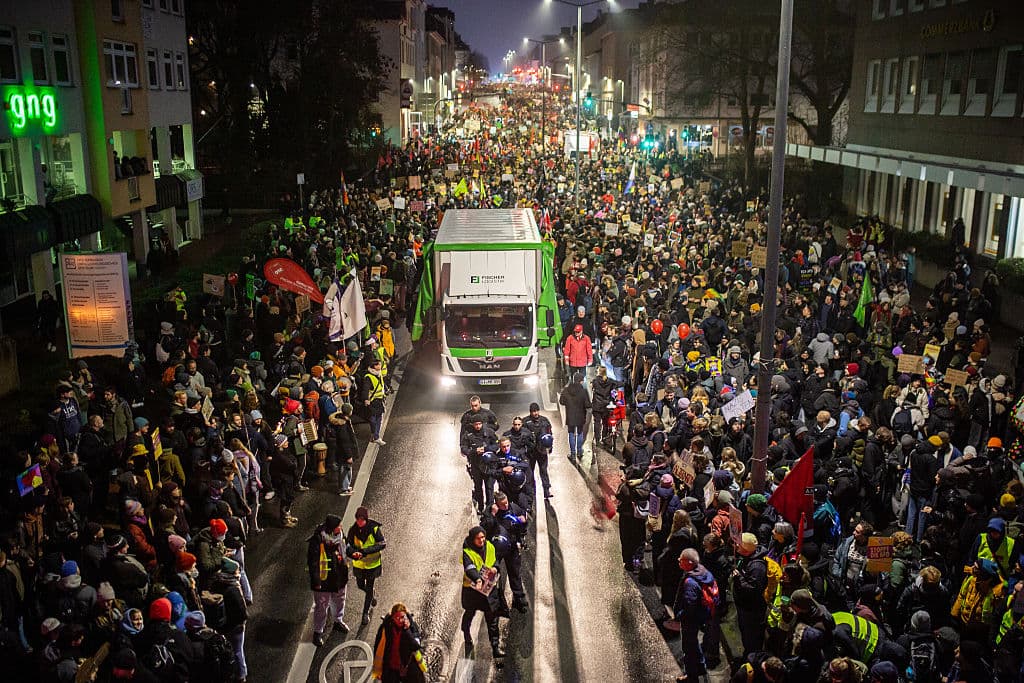
Last week, the Associated Press reports, a “confident” AfD launched its new youth organization, Generation Germany, at the city of Giessen. The previous such organization, Young Alternative, was found by German security services to be “extremist” and anti-democratic. The same judgment was lodged against the AfD itself, but that designation is suspended pending appeal. The meeting at Gissen provoked enormous protests from leftists.
One magazine, the Left Berlin, crowed that “Generation Antifa blocks the Far Right.” Perhaps the specter of “Generation Antifa” is what is driving the rise in the AfD’s popularity. The party’s anti-immigration rhetoric continues to resonate as the specter of Islamist terrorism has cast a “chill” over even Germany’s treasured Christmas markets. The broader question, though, is whether the AfD is ready to lead Germany.
That unknown gains further salience in light of the situation not only in Germany but across the continent. The Journal reports that Berlin has formulated a “secret plan for a war with Russia” as Putin rattles his saber at Europe. The AfD, which is pro-Russian and has been accused of a pro-Kremlin orientation, would seem ill-suited to tangle with Moscow. The AfD has also been scattershot in its response to Chancellor Friedrich Merz’s new military service plan.
The party is still verboten to many Germans. The FT reports that such iconic brands as the “Hamburg-based hipster cola” maker Fritz Kola and the pharmacy giant Rossmann are planning to exit the Association of Family Businesses over its invitation to the AfD. At the Giessen conference, one speaker was expelled for speaking, as Politico puts it, “in an Adolf Hitler-like manner.” Germany soon may discover what is on the firewall’s far side.

