Trump, After the Latest Violence Between Thailand and Cambodia, Seems To Have Inflamed the Crisis
Thai premier denies that Thailand and Cambodia had agreed to stop the fighting.
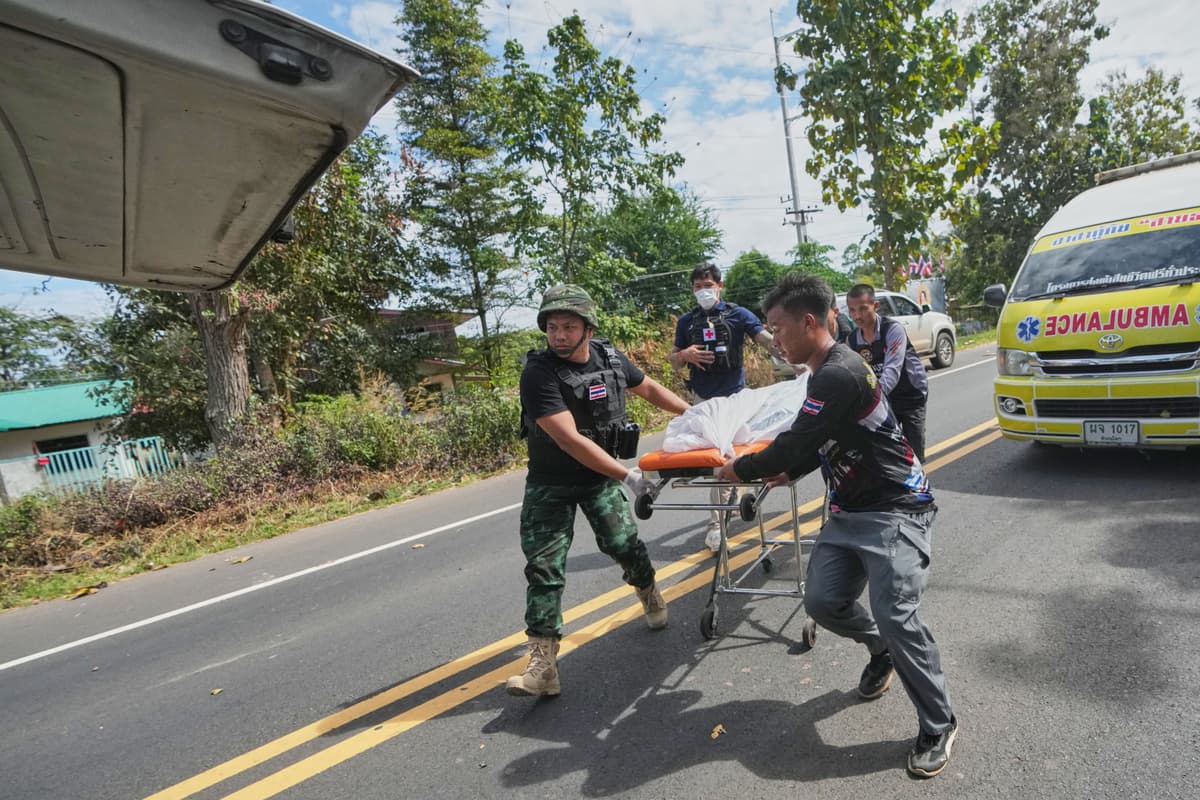

Thai and Cambodian armed forces appear certain to keep fighting despite President Trump’s claim that he’s got the two historic foes to agree to another ceasefire.
The Thai prime minister, Anutin Charnvirakul, is leaving no doubt the fighting will sputter along the border extending from an ancient temple held by Cambodia all the way to the Gulf of Thailand. Thai forces, he says, would “perform military actions until we feel no more harm and threats to our land and people.”
The killing of a 63-year-old Thai farmer by Cambodian shellfire provided yet another reason for Thai forces to conduct air strikes over Cambodian positions while the Cambodians fired back sporadically. A Thai warship has joined the fighting, firing on Cambodian positions from the Gulf of Thailand.
Thailand now claims to have killed more than 200 Cambodian soldiers as opposed to 16 of its troops killed by Cambodians, some of them by a roadside mine. Cambodia has not said how many of its soldiers have died but has reported 11 civilian deaths.
Making matters worse, President Trump seems to have upset the leader of Thailand, America’s close allys as a bulwark against Communist China since the 1950s and now bound to Washington in a “strategic alliance and partnership” signed in 2022.
Despite the Thai-American alliance, however, Mr. Anutin refused to go along with Mr. Trump’s renewed attempts to get Thailand and Cambodia to honor the ceasefire that he and the Cambodian prime minister, Hun Manet, signed in October at the confab of the Association of Southeast Asian Nations in Kuala Lumpur.
Mr. Anutin emphatically denied Mr. Trump’s assertion that Thailand and Cambodia had agreed to stop fighting, refuting the president’s suggestion that a bloody roadside bomb explosion was “an accident.” The mine explosion, he said, was “definitely not a roadside accident.” The Thai leader issued that retort almost immediately after Mr. Trump, on Truth Social, said “the roadside bomb that originally killed and wounded numerous Thai soldiers was an accident.”
Mr. Trump insisted that Thailand and Cambodia would “CEASE all shooting effective this evening” and honor the accord that he personally had brokered and witnessed at the ASEAN meeting.. Mr. Anutin’s response, however, indicated that he placed a higher priority on projecting his image to politically divided Thais as a strong leader who would not succumb to Mr. Trump’s threat to lower tariffs on imports from Thailand.
Whatever temporary respite Washington might force on the combatants, the chances of a lasting ceasefire that Mr. Trump could claim as another success in bringing about peace between warring nations appeared remote. The implication by Mr. Trump that Thailand’s response to the mining had been excessive appeared to have added fuel to the fire of Thailand’s decision to go on fighting regardless of pressure from Mr. Trump as well as Malaysia’s prime minister, Anwar Ibrahim.
Heaping scorn on postings by Mr. Trump, Mr. Anutin said “anyone can say anything,” according to the Thai website, The Nation. “If there is a ceasefire, it must be seen in practice,” he argued, “not merely stopping shots while still keeping weapons aimed at Thailand and remaining ready to shoot.”
Mr. Anutin “has so far been noncommittal on a diplomatic solution and has repeatedly backed the military to fully implement its planned operations,” The Nation surmised. “Thailand’s army has made clear that it wants to cripple Cambodia’s military capability ‘for years to come.’”
The Malaysian prime minister has emerged as the critical figure in pressing for a ceasefire in view of Malaysia’s position as Thailand’s southern neighbor, across the Gulf of Thailand from Cambodia. The Cambodian leader, Hun Manet, appeared far more interested than Mr. Anutin in an agreement under which observers from ASEAN member countries would deploy along the Thai-Cambodian border.
Thailand, however, was silent on that idea, charging that Cambodian soldiers had attacked Thai positions all along the border. The Thai military said that four Thai soldiers were killed as they fought to wrest a strategic position on a hill. Thailand, however, claimed to have decimated Cambodians, probably the victims of air strikes inflicted by its F-16 bombers.
Cambodia has a few old MiGs provided by Communist China that might be used for ceremonial purposes but no planes capable of sending into combat. The Thai response appears in large measure to reflect the desire of Thai authorities to prove Thailand’s superiority over its smaller neighbor.

