Trump’s Deal in Ukraine, on Its Face, Looks Like a Great Double Victory for the West
It offers a sovereign Ukraine solidly in the West with reliable security guarantees, while Russia would be enticed back from the bowels of Eastern Asia.
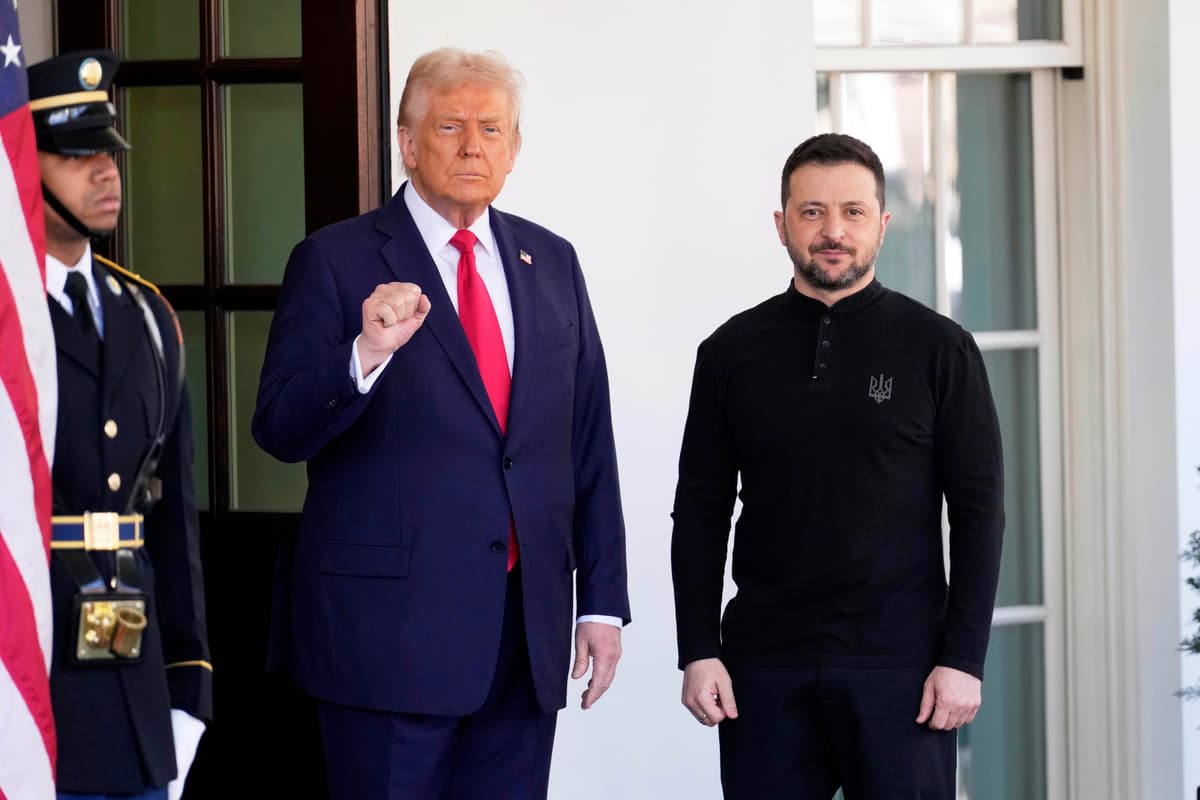

The brickbats are already flying from President Trump’s critics, at home and abroad, over his proposed peace plan for Ukraine. To evaluate that plan we must recollect the correlation of forces at the outset of the Ukraine war. The Biden administration’s initial reaction to the Russian invasion in February 2022 was to offer President Volodymyr Zelensky and his family refuge as the inept and insubordinate chairman of the Joint Chiefs, General Mark Milley, confidently announced that Russia would occupy Kyiv within a few days and all Ukraine within a month.
As the Ukrainians resisted heroically, (their army had been well-trained for the past eight years by various North Atlantic Treaty countries), the Western Europeans began raising their defense budgets, and they and the United States and Canada began feeding in military supplies to Ukraine, sufficient to prevent defeat, but never enough to permit victory. There was no Western exit strategy, just attritional terms like “as long as it takes.”
Russia has occupied approximately 15 percent of Ukrainian territory, taken more than 1 million casualties, suffered approximately hundred thousand deserters, and more than half a million conscription evaders and is paying for this essentially by selling oil gas to Western Europe as it supplies weapons to Ukraine, and oil at knockdown prices to Russia’s Communist Chinese “ally.”
Russia’s gross domestic product is smaller than Canada’s, and it cannot afford this effort. Nor can the regime in the Kremlin disguise from the public the failure of the mission. At the outset, President Vladimir Putin denigrated Ukraine as a non-country. The jurisdiction was invented by Lenin 300 years after Peter the Great had occupied the territory then populated by a hodgepodge of Poles, Lithuanians, Russians, and Tartars (Asiatic Russians).
The population was never impressed with communism and initially greeted the invading Germans in 1941 as liberators. Crimea, which had been Russian since 1783, was allocated in 1954 to Ukraine by Stalin’s successor as Soviet leader, Nikita Khrushchev, who had been the senior official in Ukraine for 15 years. After seceding from the Soviet Union in 1991, Ukraine was effectively a failed state because of its unstable government and chronic corruption, until it responded so vigorously to the Russian invasion of 2022.
In 1993 Ukraine, Belarus, and Kazakhstan gave up the nuclear weapons they had inherited from the Soviet Union in exchange for guarantees of their borders by Russia, China, the United States, the United Kingdom, and France. These guarantees proved to be worthless. There was extensive infiltration and skirmishing by Russia in the largely Russian-speaking eastern regions of Ukraine for years and the Minsk agreements of 2014 and 2015, which aimed to de-escalate that conflict, finally failed completely with the Russian invasion of 2022.
There were reciprocal charges of bad faith as well as problems of Russian and Western interference in successive Ukrainian elections. The Russians do have a claim to some historic status in part of Ukraine, and the Ukrainians have convincingly demonstrated their determination not to be reabsorbed into Russia. Peter the Great’s Russia was built up when there was no Western influence in Eastern Europe. Stalin’s USSR replicated Peter the Great’s with Western support as part of the combined effort against Nazi Germany. These conditions no longer exist.
There were no serious efforts at a negotiated peace prior to Mr. Trump’s reelection. His plan appears to include the concession to Russia of what it has already occupied of Ukraine and a few eastern additional areas for a total of less than 20 percent of the country and most of the Russian-speaking area. The population of these areas would presumably be free to move to Ukraine in its new borders if they wished. Mr. Trump deftly pressured NATO into raising its defense budgets and got rid of isolationist objections in his party by selling advanced weapons to the European allies who then give them to Ukraine.
More than 80 percent of Ukraine in its new borders would form an unquestioned sovereign country with guarantees from NATO equivalent to the guarantees that exist between the NATO powers themselves. Although Ukraine’s armed forces would be capped at 600,000, it would be understood that a further Russian invasion would be considered an attack on the NATO Alliance. Elections would be held in Ukraine within 100 days and a powerful influence would be exercised by the West to ensure that Ukraine made a serious effort to develop effective political institutions.
Russia would then be welcomed back into or at least toward the West and out of the potentially deadly embrace of China. Sanctions would be eliminated in stages and increased levels of commercial interchange between Russia and the West would be encouraged. If Russia had been successful in occupying all of Ukraine, the Western alliance would have been exposed as a paper tiger and Russia would have regained the largest single element of its defeat in the Great Western strategic victory of the Cold War.
If Russia were severely defeated in the Ukraine war, we would have to fear that China would make arrangements to exploit the resources of Siberia, paying a royalty to the Kremlin. China would thus become a much stronger power than it has ever been and the undoubted leader of the entire Eurasian landmass. Prevention of such a state of exploitive intimacy between China and Russia has been Mr. Trump’s second objective throughout this war, after the prevention of an outright Russian victory over Ukraine.
The details of such an agreement have yet to be disclosed, and Mr. Trump has stated that the terms are not final. On its face, this is a great double victory for the West: A sovereign Ukraine solidly in the West with reliable security guarantees and Russia is enticed back from the bowels of Eastern Asia to a constructive framework of relations with the West. At this early point, it looks like another strategic and humanitarian victory for Mr. Trump, ending a war that has caused approximately 10,000 casualties a week for nearly four years.

